Other PicoMicroYacht

Friday, 30 August 2019

The Selsey Bill Trilogy: Pagham, visions of angels, Jerusalem and mindfulness

This is the first of three posts describing a voyage from Felpham to Chichester Harbour via Selsey Bill.

My first row was from Felpham to Pagham harbour, just a long the coast, returning to Felpham on the same day.


Felpham is a small village to the east of Bognor Regis. Launching there is very civilised, with a good slipway leading down to hard sand at low tide.

Close to the slipway is the lovely cottage where the poet William Blake wrote 'Jerusalem' with the lines: 'I will not cease from mental fight, Nor shall my sword sleep in my hand. Till we have build Jerusalem in England's green and pleasant land.'

Felpham is mentioned in a Blake poem: 'Away to sweet Felpham, for Heaven is there. The ladder of angels descends through the air.' He claimed to have seen visions of angels on many occasions, starting aged eight years old, when walking from Soho to Peckham in London.

I didn't see any angels but was more preoccupied with launching PicoMicroYacht, having only one hour of fair tide left.

I decided to skirt over the reef at Bognor, due to the calmness of the sea. This reef has the appearance that some giant has sporadically lobbed boulders into the sea. Out to sea the rocks were visible and a threat to any passing yacht.


I moved forward gingerly, on the lookout for submerged rocks and circumventing them when seen.

Although there was some choppiness from the waves, there was no swell. A line of buoys marking lobster pots were at the end of the reef and I noted this for my return.

Further on I saw a post and the remains of a large concrete slab. This had been fabricated in 1944 to be used as part of the Mulberry Harbours to for the D-Day landings. It never made it across the Channel.


A head wind meant it was relatively slow going and the tide began to turn against me as I reached Pagham.

The sailing club announced itself with flags and a sign, easily seen from out at sea.


Beyond the club was the entrance to Pagham Harbour, which I reached at low tide. I beached briefly on a shingle bed in the middle of the channel, having rowed very carefully though sea grass.


The water trickled over the shingle bed .

After a short break I pulled the boat out into deeper water and returned, the wind and the tide making it a quick journey.

It took around two hours to reach Pagham, and the return was in about one hour.

I had captured the sound of the water over the shingle, a sort of mindfulness experience.


Tuesday, 6 August 2019

A voyage past Dancing Beggars


This was a journey from Dartmouth down to Torcross, a voyage of about seven nautical miles.

The plan was to leave Dartmouth on an ebb tide and catch the start of the tide going down Start Bay, a simple voyage. I set off at midday to catch the tide out of the harbour.

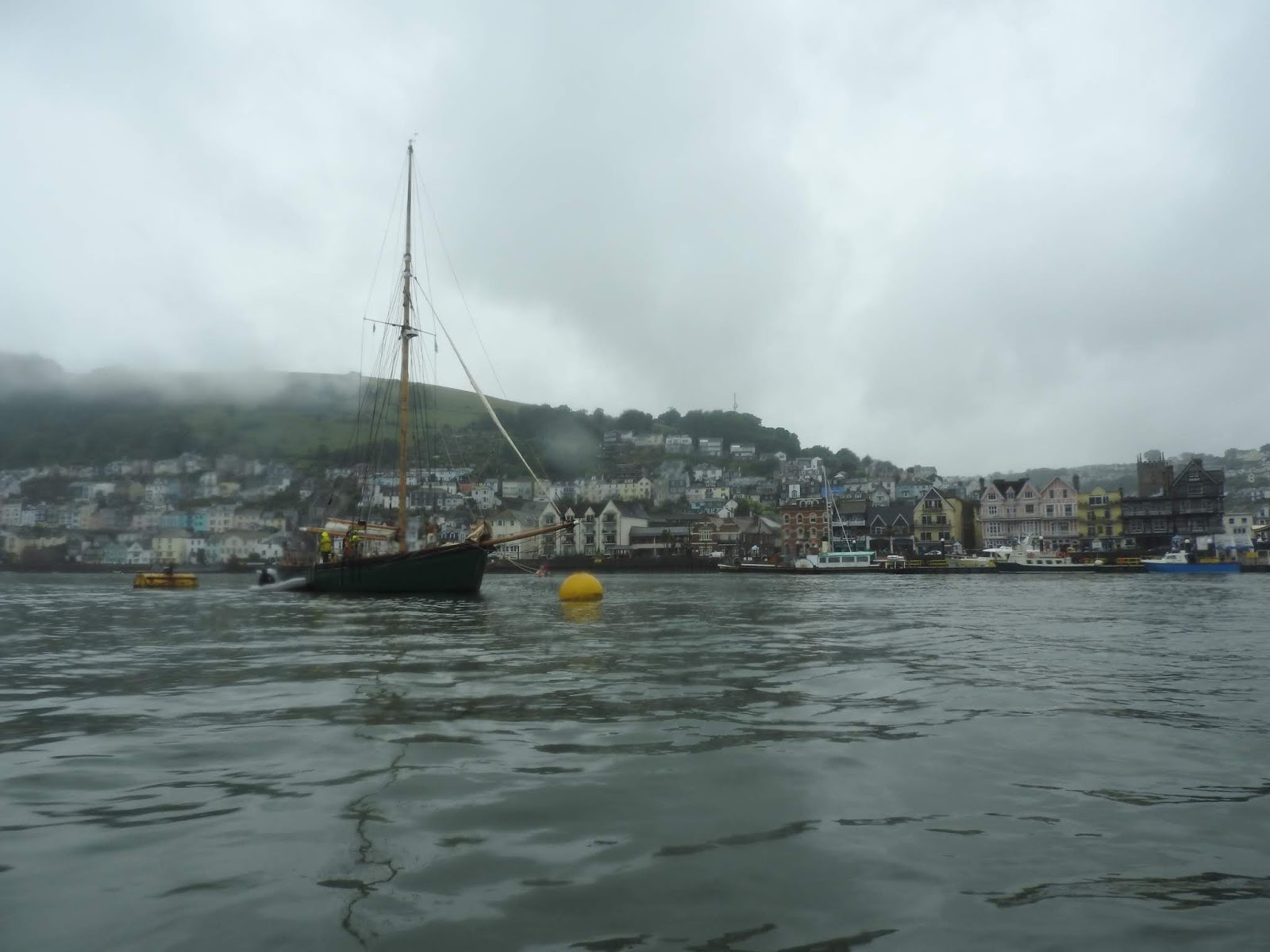
There was low cloud and slight drizzle when I started, but the weather started to clear. Although there was low light for photography, the weather effects made Dartmouth more atmospheric.


The colours and tones blended in a way that made everything seem like an impressionist painting.

I looked up at the Britannia Royal Naval College where my uncle had trained, starting aged 13 years.  His first action was four years later, when at dawn on D-Day, his ship, the H M S Warspite bombarded enemy gun emplacements from eight miles offshore. He was attacked by E Boats, before forcing a retreat. His ship wore out their 15 inch guns and went back to Portsmouth. (see: http://stevespages.org.uk/pgm-greig/warspite.html)


As I exited, there were some yachts coming in, with the crews trussed up in their sailing gear, having been voyaging in the rain.


The lack of wind and stillness, meant their conversation carried over the sound of their engines and I heard one person talking about PicoMicroYacht, saying ‘… and it has a radar reflector on the top of it’s mast …’

At the mouth of the Dart Estuary I went along the southern side of the channel. 

The Kingwear Castle arrived, this ship being the last remaining operational coal fired paddle steamer in the UK.

It headed straight for me and I wondered what evasive action I should take, if any.


It then became clear it was turning and having to create the widest arc to go around smoothly.


Further down the coast was a reef with a series of rocks called the Combe Rocks. Because of the calmness of the sea I decided to go between the Dancing Beggar and Combe Rocks rocks, gingerly moving forwards, also sticking to a path made by lobster pot buoys. The Dancing Beggar rocks were to starboard.


Looking back towards Dartmouth I could see the rocks and also Mew Stone rock in the far distance. I was wondering whether low clouds would decend and create a fog.

Soon I was closing in on Torcross, with Start Point in the distance, the sea now silky smooth.


When I arrived, the tide was out but the small stoned shingle beach made it easier to drag PicoMicroYacht upwards.

To make it easier I emptied the PicoMicrYacht of all gear, including the rowing system, which is easily detachable.  This reduced the weight to bare hull 60 kilograms.

I then rigged a bridle attached to bow and used a towing technique. I walk two metres up the beach, faced PicoMicroYacht, and slipped the bridle over my lower back. I then leant backwards. The weight of my body provided enough force to slide PicoMicroYacht forwards for a few inches, at which point I adjusted my legs and repeated the process.

PicoMicroyacht inched up the beach with comparatively little effort. As the beach got steeper, I slalomed up it to reduce the angle. 

Because PicoMicroYacht moves so slowly, quite often people see what I am doing and offer to help anyway.

I took a photograph of my radar reflector, which is set up so I can attach a navigation light on top.


Voyage details:

Plymouth high tide: 7.50 am
Tide: Springs
Left Dartmouth: Midday
Arrived Torcross: 3.30 pm
High tide Plymouth on 19 06 19 was 7.50. Set off at 12.00 midday when the tide turned south down Start Bay (four hours after high tide Plymouth)

Tuesday, 11 June 2019

Slapton Sands to Salcombe


The plan was to launch PicoMicroYacht off Slapton Sands and row round to Salcombe.


Path of PicoMicroYacht from Slapton Sands to Salcombe

The voyage required some careful planning because I needed to time it so that when I got to Start Point it would be slack water and I would avoid a race on this headland.

Although it was nearly neaps, a residual swell coming in from the west would have made it very bumpy.

Also, a main difficulty for the voyage would be going against a force three to four West-South-West wind. As well as making it harder work, the wind against tide would tend to ruffle up the waves.

I realised that if I left an hour and a half just before approximate slack water at Start Point, there would be a back eddy that would help me on my way southwards.


In the middle of the chart is shown the back eddy down Start Bay, ending at Start Point


Slack tide or thereabouts at Start Point, three hours after high tide at Plymouth: The more detailed map on the right bottom shows a slight eddy already going south and west just off Start Point.


An hour later the tide gets going towards the Prawle Point

The main English Channel tide would be in my favour all the way to Salcombe.

After reaching Start Point, I needed to take my time so as not to arrive too early in Salcombe, avoiding the strong ebb tide coming out of the harbour.

It was three days after the 75th D-Day Anniversary. The Slapton Sands had featured prominently before the D-Day Landings because of being used as an invasion practice beach.  


A Sherman tank, placed there now as a memorial, was decked by wreaths commemorating I think not the actual landings but deaths that occurred during practice.

PicoMicroYacht was rigged and slid down the beach, ready to launch.


I then waited for smaller waves before launching, then giving PicoMicroYacht a vigorous push and leaping onto it just as it entered the water. It was just before 12 O’Clock, mid-day.

Along Start Bay are the coastal villages Beesands and Hallsands. The latter was washed away in storms in 1917, the protective shingle beach having been dredged to help build a naval dockyard in Plymouth.


Beesands and houses behind the sea wall


Hallsands, with the ledge to the left where the village was washed away in storms.

Soon I was at Start Point at exactly slack tide.


Start Point sticks out in a C shape, with Froweder Cove in the middle of the C. I rounded the top half of the C about five metres off the rocks and then went between the bottom half of the C and the Black Stone rock.


Ordinary it is advised not to do this inner passage without local knowledge. I realise why when I saw to my right a large round yellowish patch in the water the size of a small trampoline.

At first, I thought it was a mass of weed, but then I saw it was a rock I had narrowly missed going over.


The  position of the rock PicoMicroYacht narrowly missed passing over just off Start Point


One of the potmarkers close in off Start Point, the submerged rock about five metres behind.

In addition to this rock there was a network of potmarker buoys ready to catch the unwary engine powered boat, tangling their propellors with their underwater lines.

After rounding Start Point, the sea increased, and it was slow going. As PicoMicroYacht neared Prawle Point, the land protection had gone, being at the most southerly point of South Devon.

Large rolling waves came in from the West and I began to feel slightly seasick.

At this point a succession of yachts passed me, two of which altered course to go close and check whether I was alright. A motorboat also came along side and asked me where I was going, having trouble hearing me over the noise of his engine.


Yachts passing close to me. By this time the wind was lessening.

Opposite Prawle Point the sea was more disturbed as the westerly going tide accelerated against the waves. However, the wind was dropping.

I did a radio check to the Coastwatch at Prawle, using Channel 65, mainly to let them know I was alright, since they would have been monitoring me.

The sea started to calm and the entrance to Salcombe was a welcome sight.  I was able to row with less effort against the lessening wind, which was by then more on my beam.


Closing in on Salcombe

It was now just after 5 pm and I half drifted up the estuary to Whitestrand Quay. On the way, I was overtaken by the South Sands ferry.


The slow speed of the voyage (average about 2 knots) was accounted for by the head wind and the ruffled sea.

Voyage Planning:

11th June 2019
High Water Plymouth: 11.00
Neaps at 13th June 2019
Start Torcross at 12.40 (southern going eddy down Start Bay)
Arrive Start Point at 14.10 (slack water): Distance 2.8 NM
Arrive Prawle Point at 15.40 (westerly going tide): Distance 3.6 NM
Arrive Salcombe Entrance at 17.00 (westerly going tide; just before low water, Salcombe): Distance 2.4 NM
Total Distance: 8.8 NM
          
Mean Speed: Approximately 2 knots


Saturday, 20 April 2019

Hastings to Eastbourne and an imaginary armada


This voyage was a pleasant short trip along the South Coast of England, with no dramatic headlands or races to avoid. The start was St Leonards-on-Sea, just west of Hasting, and the finish was Eastbourne


The white line is the route taken by PicoMicroYacht

I launched off a pebble beach, which was steep as it met the sea. Waves were breaking quite sharply, with a distinct undertow. I waited for the larger waves to finish and then pushed PicoMicroYacht quickly into the sea so as not to get tangled up with the breaking waves.

I tried to leap aboard at the last minute, but my timing was wrong, and I ended up in the water.  I hauled myself over the side, grabbed an oar and paddled away quickly.


Looking back, I saw the Royal Victoria Hotel, built originally in the Georgian era, subsequently made famous by the visits of Queen Victoria, when St Leonards-on-Sea was a fashionable resort for the rich.


Although the weather was settled and calm, mists blocked the sunlight and gave the coast a somewhat mysterious air.


I began to imagine the approximately 700 ships that arrived on this coast when William the Conqueror invaded England in 1066, picturing a huge armada of Viking like boats appearing out of the mist. I found out later the boats were beached on arrival, and a garrison established to guard them whilst the army went onwards.


The tide started to flow west, aa I could see this from the various buoys I passed.

It did not seem so long before PicoMicroYacht was at Eastbourne’s Sovereign Harbour, where boats were going in and out.


This included a Canadian cat rigged yacht, who sailed across to chat to me and ask whether I was going around the UK.


A brightly coloured fishing boat steamed past in a hurry, lit by the sun as the mists started to disperse.

In the distance was Eastbourne with the Pier and behind it the distinctive Beachy Head cliffs, where the South Downs meets the sea. The dreamy misty look was worthy of an impressionist painting.


As I got closer to my destination, the mists were clearing and a bright blue sky was pushing through. An outer reef helped break the waves slightly, so it was an easy landing on the beach.


The tide was fully out now, and it took a long time to drag PicoMicroYacht up the beach to the sailing club.

Sunday, 7 April 2019

PicoMicroYacht celebrates Morris K Morris after nearly 96 years


Mostly I row in PicoMicroYacht, but last Friday I had the privilege of visiting London Rowing Club at Putney for a rowing eight outing. The scratch crew consisted of four members of my extended family, with other oarsmen from London Rowing club completing the crew.

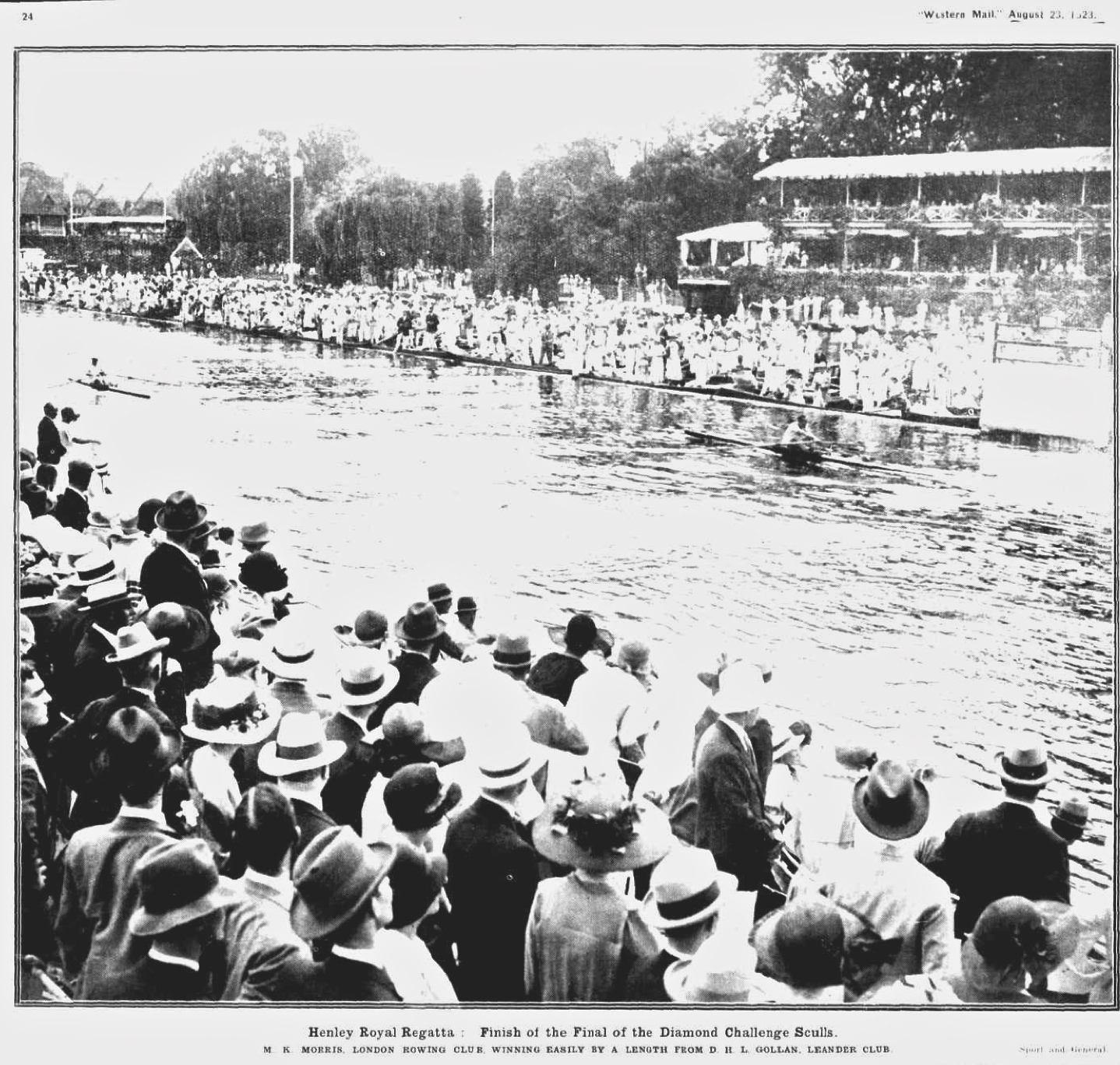
The purpose was to commemorate Morris K ‘Geoff’ Morris, a relative who won the Diamond Challenge Sculls at Henley Royal Regatta nearly 96 years years ago, and whose photograph was being unveiled in the club house.

The rowing journalist Tim Koch had organised the event and brought together the Morris family either to row or to watch.


Timothy Koch in the foreground, who coxed the scratch Morris and London Rowing club eight

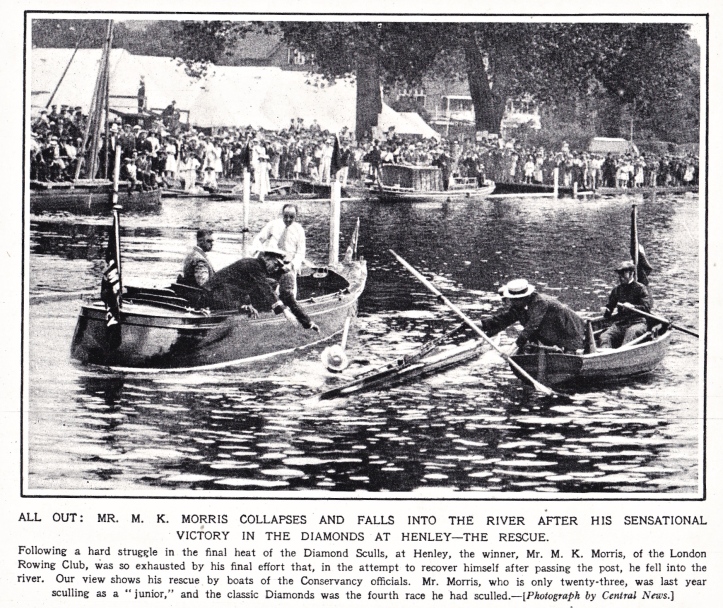
Morris K Morris won the Diamond Challenge Sculls in sweltering heat, unexpectedly beating off the competition in only his fourth formal racing event. He was so tired at the final finish that he fell in and had to be rescued.


Morris K Morris goes on to win the final of the Diamond Challenge event, beating D H L Gollan

Pic 15. After crossing the finish line, an exhausted Geoff fell in. Unfortunately, he did not lose his terrible hat.

The newpaper account of MK Morris being rescued

In our scratch rowing eight, three Morris’s combined with Jeremy Fisher Smith, whose father was a step son of MK Morris. 


The Morris/ London Rowing Club scratch rowing eight. Jeremy Fisher Smith is number two, Robin Morris number three, Ed Morris number four and Sean Morris, the veteran rowing champion, is number seven.

Together, we found that we could still row roughly in time with sweep oars and sliding seats, with only one slight crab occurring in an hour’s rowing despite a lively breeze and messy water. After the row we went to the club for the unveilling of the photograph. The average age of the crew was nearing 70 years old.


The photograph being unveilled


The Fisher Smith website, with a photograph of a rowing skiff built by Jeremy; note the diamond shape used in the insignia design, a nod towards MK Morris winning the Diamond Challenge event.

It was my first meeting with Jeremy who is an expert boat builder, who crafts superb classic wooden boats as well as running a boatyard near San Francisco. It was a privilege to meet Jeremy and chat about all things boating, including the fun we both have sea adventuring in small open boats.

It was two days before the Oxford and Cambridge boat race and we shared the club with the Cambridge men’s boat crew, discretely ignoring them so as not to interfere with their coaching.

This made it more special when today Cambridge won the boat race, their number two oarsman being James Cracknell, the oldest person to row in the boat race by 10 years and following recovery from a serious brain injury.


Cambridge win by a length in a tight race

Tuesday, 26 March 2019

Breaking a rule at the English Riviera and seeing a dolphin

Whilst the South Coast of England will never be as glamorous as the French Riviera, the  area of Devon that encompasses Torquay, Paignton and Brixham makes a good attempt.

These three towns are clustered around Tor Bay, well protected from the prevailing westerly winds and  the swell that comes from the Atlantic Ocean.


I was to cross Tor Bay, a voyage of about 4.5 miles, and then row along the rugged coast between Brixham and Dartmouth.


The voyage taken by PicoMicroYacht. The English Riviera is defined by the green line

I had chosen a day when there was a full spring tide, going against my usual rule to row at neaps. However, the wind was forecast to be Force 1-2 from the west, and the sea state was reportedly smooth or slight. Also I was capitalising on being shielded by the South Devon land mass, Tor Bay facing east.

As I set off a Sadler 26 was cleaning their copper coated bottom on the main Torquay slipway. The owner had chatted to me as his helper worked on the boat and explained he knew about PicoMicroYacht, having sailed the Devon coast in a 17 foot open boat.


I set off and found it seemed to be slow going crossing Torbay, despite the forecast, as a light headwind got up from an unpredicted direction and the tide had not yet turned in my favour.

Passing Brixham, this all changed and the wind disappeared, with the tide now sizzling past the coast and setting up areas of sea turbulance around the exposed headlands, but not enough to worry PicoMicroYacht. 

As I looked to the side I saw some lobster pot buoys submerged in the water, as the tide tugged on them. A dolpin showed up but was too fleeting to be photographed.

Nearing Dartmouth the sea was near glassy calm.  Start Point is shown in the distance.


Behind was the Mew Stone, a large jagged rock typical of the Devon coast


Soon I was just outside Dartmouth and eating lunch whilst I waited for the tide to start flooding up the Dartmouth Estuary.

The Darthaven Marina were most welcoming and allowed me to keep PicoMicroYacht on their pontoons for a while as I sorted myself out.