Other PicoMicroYacht

Saturday, 20 April 2019

Hastings to Eastbourne and an imaginary armada


This voyage was a pleasant short trip along the South Coast of England, with no dramatic headlands or races to avoid. The start was St Leonards-on-Sea, just west of Hasting, and the finish was Eastbourne


The white line is the route taken by PicoMicroYacht

I launched off a pebble beach, which was steep as it met the sea. Waves were breaking quite sharply, with a distinct undertow. I waited for the larger waves to finish and then pushed PicoMicroYacht quickly into the sea so as not to get tangled up with the breaking waves.

I tried to leap aboard at the last minute, but my timing was wrong, and I ended up in the water.  I hauled myself over the side, grabbed an oar and paddled away quickly.


Looking back, I saw the Royal Victoria Hotel, built originally in the Georgian era, subsequently made famous by the visits of Queen Victoria, when St Leonards-on-Sea was a fashionable resort for the rich.


Although the weather was settled and calm, mists blocked the sunlight and gave the coast a somewhat mysterious air.


I began to imagine the approximately 700 ships that arrived on this coast when William the Conqueror invaded England in 1066, picturing a huge armada of Viking like boats appearing out of the mist. I found out later the boats were beached on arrival, and a garrison established to guard them whilst the army went onwards.


The tide started to flow west, aa I could see this from the various buoys I passed.

It did not seem so long before PicoMicroYacht was at Eastbourne’s Sovereign Harbour, where boats were going in and out.


This included a Canadian cat rigged yacht, who sailed across to chat to me and ask whether I was going around the UK.


A brightly coloured fishing boat steamed past in a hurry, lit by the sun as the mists started to disperse.

In the distance was Eastbourne with the Pier and behind it the distinctive Beachy Head cliffs, where the South Downs meets the sea. The dreamy misty look was worthy of an impressionist painting.


As I got closer to my destination, the mists were clearing and a bright blue sky was pushing through. An outer reef helped break the waves slightly, so it was an easy landing on the beach.


The tide was fully out now, and it took a long time to drag PicoMicroYacht up the beach to the sailing club.

Sunday, 7 April 2019

PicoMicroYacht celebrates Morris K Morris after nearly 96 years


Mostly I row in PicoMicroYacht, but last Friday I had the privilege of visiting London Rowing Club at Putney for a rowing eight outing. The scratch crew consisted of four members of my extended family, with other oarsmen from London Rowing club completing the crew.

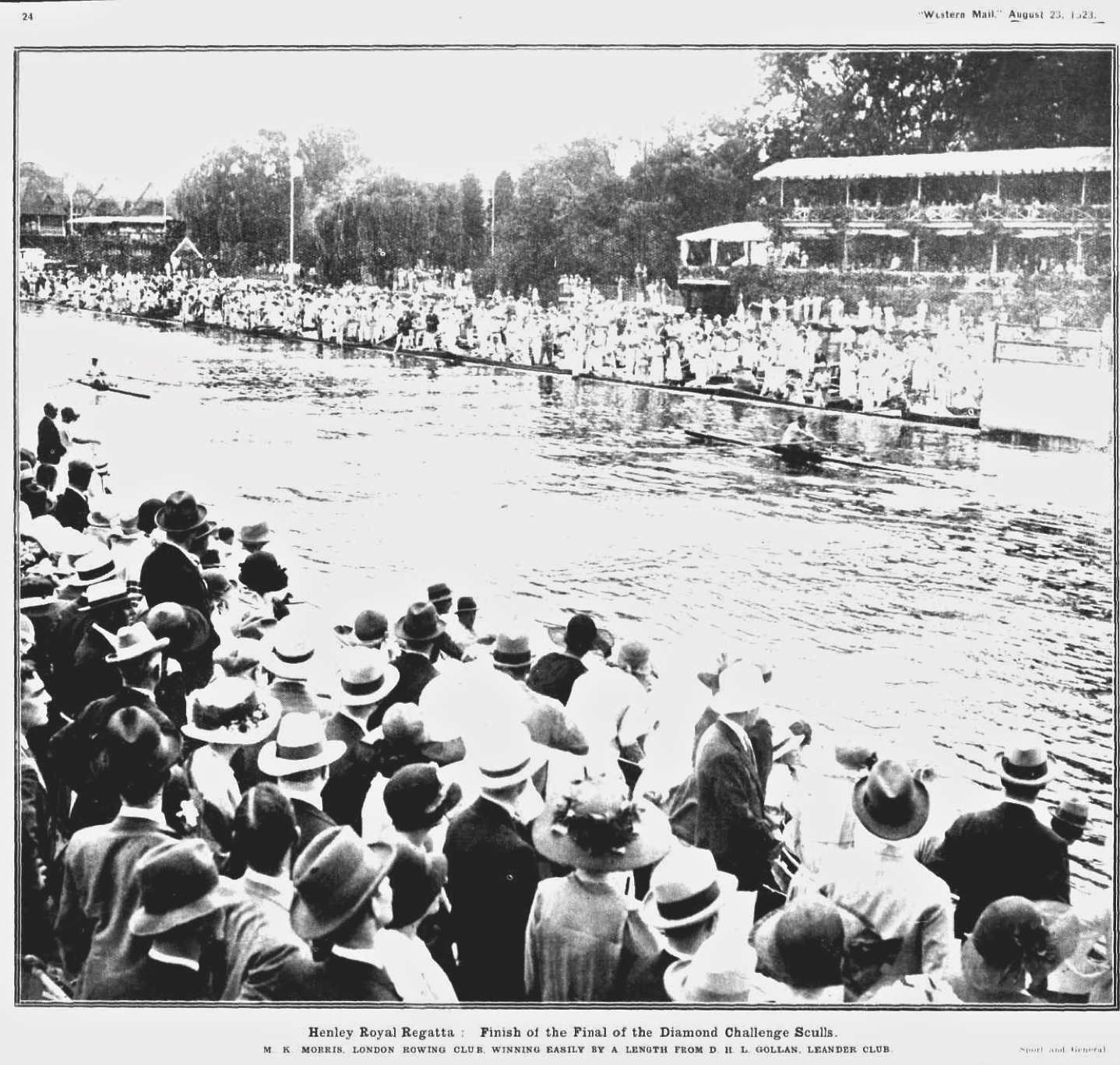
The purpose was to commemorate Morris K ‘Geoff’ Morris, a relative who won the Diamond Challenge Sculls at Henley Royal Regatta nearly 96 years years ago, and whose photograph was being unveiled in the club house.

The rowing journalist Tim Koch had organised the event and brought together the Morris family either to row or to watch.


Timothy Koch in the foreground, who coxed the scratch Morris and London Rowing club eight

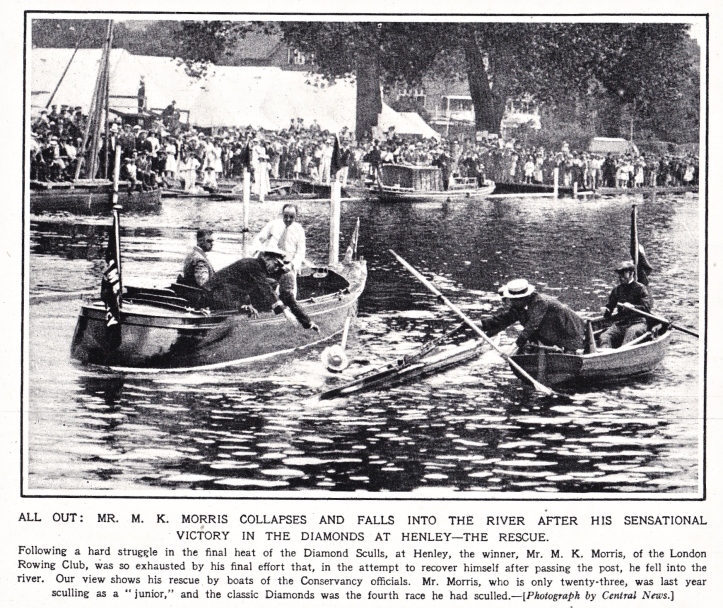
Morris K Morris won the Diamond Challenge Sculls in sweltering heat, unexpectedly beating off the competition in only his fourth formal racing event. He was so tired at the final finish that he fell in and had to be rescued.


Morris K Morris goes on to win the final of the Diamond Challenge event, beating D H L Gollan

Pic 15. After crossing the finish line, an exhausted Geoff fell in. Unfortunately, he did not lose his terrible hat.

The newpaper account of MK Morris being rescued

In our scratch rowing eight, three Morris’s combined with Jeremy Fisher Smith, whose father was a step son of MK Morris. 


The Morris/ London Rowing Club scratch rowing eight. Jeremy Fisher Smith is number two, Robin Morris number three, Ed Morris number four and Sean Morris, the veteran rowing champion, is number seven.

Together, we found that we could still row roughly in time with sweep oars and sliding seats, with only one slight crab occurring in an hour’s rowing despite a lively breeze and messy water. After the row we went to the club for the unveilling of the photograph. The average age of the crew was nearing 70 years old.


The photograph being unveilled


The Fisher Smith website, with a photograph of a rowing skiff built by Jeremy; note the diamond shape used in the insignia design, a nod towards MK Morris winning the Diamond Challenge event.

It was my first meeting with Jeremy who is an expert boat builder, who crafts superb classic wooden boats as well as running a boatyard near San Francisco. It was a privilege to meet Jeremy and chat about all things boating, including the fun we both have sea adventuring in small open boats.

It was two days before the Oxford and Cambridge boat race and we shared the club with the Cambridge men’s boat crew, discretely ignoring them so as not to interfere with their coaching.

This made it more special when today Cambridge won the boat race, their number two oarsman being James Cracknell, the oldest person to row in the boat race by 10 years and following recovery from a serious brain injury.


Cambridge win by a length in a tight race

Tuesday, 26 March 2019

Breaking a rule at the English Riviera and seeing a dolphin

Whilst the South Coast of England will never be as glamorous as the French Riviera, the  area of Devon that encompasses Torquay, Paignton and Brixham makes a good attempt.

These three towns are clustered around Tor Bay, well protected from the prevailing westerly winds and  the swell that comes from the Atlantic Ocean.


I was to cross Tor Bay, a voyage of about 4.5 miles, and then row along the rugged coast between Brixham and Dartmouth.


The voyage taken by PicoMicroYacht. The English Riviera is defined by the green line

I had chosen a day when there was a full spring tide, going against my usual rule to row at neaps. However, the wind was forecast to be Force 1-2 from the west, and the sea state was reportedly smooth or slight. Also I was capitalising on being shielded by the South Devon land mass, Tor Bay facing east.

As I set off a Sadler 26 was cleaning their copper coated bottom on the main Torquay slipway. The owner had chatted to me as his helper worked on the boat and explained he knew about PicoMicroYacht, having sailed the Devon coast in a 17 foot open boat.


I set off and found it seemed to be slow going crossing Torbay, despite the forecast, as a light headwind got up from an unpredicted direction and the tide had not yet turned in my favour.

Passing Brixham, this all changed and the wind disappeared, with the tide now sizzling past the coast and setting up areas of sea turbulance around the exposed headlands, but not enough to worry PicoMicroYacht. 

As I looked to the side I saw some lobster pot buoys submerged in the water, as the tide tugged on them. A dolpin showed up but was too fleeting to be photographed.

Nearing Dartmouth the sea was near glassy calm.  Start Point is shown in the distance.


Behind was the Mew Stone, a large jagged rock typical of the Devon coast


Soon I was just outside Dartmouth and eating lunch whilst I waited for the tide to start flooding up the Dartmouth Estuary.

The Darthaven Marina were most welcoming and allowed me to keep PicoMicroYacht on their pontoons for a while as I sorted myself out.

Wednesday, 13 March 2019

When would PicoMicroYacht Capsize?

When doing sea rowing I have adopted three rules about the sea that I try to follow in order to allow going on voyage. Generally, it should be neap tides, so reducing the tidal rate and therefore the likelihood of a confused or breaking sea, particularly past headlands. Secondly, there should be little or no wind. This rule tends to ensure the sea is calmer, but it also means the boat is generally manoevrable in different directions. Finally, the sea shoud be calm, with little or no swell.


Sea state defined in terms of wave height

For sea calmness, I listen out for shipping forecasts that indicate that the sea is ''smooth' or 'slight.'

I had become curious as to what makes it 'slight' and how this was judged. So I checked the criteria and found that there was also calm (glassy and rippled), with below 0.1 metre wave height, and then  'smooth'  was  between 0.1 and 0.5 metres, and slight was 0.5 to 1.25 metres.

I realised that that the online coastal wind forecasts had predictions of wave heights and by chance I had been  using a 'less than one metre' rule as well, which I now realised matched approximately the 1.25 metre limit for 'slight.'

An example is the forecast for next week in the sea area of my next voyage, given below. The wave height is along the last but bottom row and shows a convenient 0.5 to 0.6 metre range, well within my limits.


Windfinder predictions for Torbay, Devon, UK

For me, the reason to have a calm sea in PicoMicroYacht is to prevent capsize. There are generally two causes of capsize; either the wind pushes on the sails to turn the boat over, or the boat gets hit by a higher than expected breaking wave, washing against it with such force that it knocks it over. It is the possibility of the latter that concerns me.

The sort of wave height ranges that I row in are well below causing other problems, such as sea sickness.

But what wave height would cause PicoMicroYacht to capsize and is my approximate one  metre  rule reasonable?

I found out about a study by the University of Southamptom Department of Ship Science. This study indicates that a boat will tend to roll over if the wave hits you on the beam, the wave is breaking and the wave height is 30% of the hull length.

Applying this to PicoMicroYacht, this meant the waves should not be more that 1.14 metres, to avoid the 30% threshold.

However, whether a capsize will take place is of course more complicated. The criteria assume the waves will break and this depends in turn on other sea conditions, including shallowing water and races. Generally, for the sea to break on shallow water at the sort of wave height range I would encounter means I would be nearly aground, such as on a sandbank or beach. More of a problem are races, which I tend to avoid by going further out to sea or by passing through the race area at slack tide. It also depends on how the boat is being manoevred. For example, facing the boat into or away from the waves reduces the likelihood of capize.


Optimist dinghies have fun going through the Fiddlers race in the west end of the Solent. I went through this race in the dark in 2016 on my way round the Isle of Wight, but in very calm weather.


There is also the issue of  the particular boat. Each has it's own right moment, the degree to which the boat will resist being turned over. The resistance tends to increases as a monohull heals, reaching a critical point when it starts to decrease and then the boat will more likely turn turtle. Many boats have their righting moment function plotted, as shown figuratively below.


Stability shown figuratively according to angle of heel (artwork by Andrew Simpson)


Since PicoMicroYacht has no weighted keel, it is more likely to flip over, with less upright stability. Also if capsized, the crew has to right it, as with most dinghies. However, as I have posted before, the PicoMicroYacht has the advantage in this situation of being rapidly self draining and easy to get back in, with very low top sides. The daggerboard is kept down whilst at sea and can then be used lever the boat upright.

Part 1


Part 2


A Pico being righted using the daggerplate; Part 1 and 2 
 (Part 2 shows how to get back on board without falling in the water again)


Friday, 1 March 2019

Why now not to cross the English Channel in PicoMicroYacht

When I crossed the English Channel in 2012, I did so with a support boat. This boat had a professional crew and was well equipped with radar, spending the whole voyage on look out, ready to act if necessary. The English Channel around Calais and Dover is potentially a very dangerous place, with about 400 ships a day passing at speed up and a comparatively small stretch of water. The weather can change very rapidly, increasing the associated risks.


Migrants in a dinghy near Calais in August 2018

Halfway across, I passed through two standing waves, created by the huge container ships that plough up and down relentlessly. I was swamped by these waves, but PicoMicroYacht is quickly self-draining,  so I was able to carry on. I also ran into unexpected fog and my safety depended on the radar system of my support boat.

Image result for picomicroyacht

In recent years, more and more people have been trying to cross the Channel in small boats, unsupported. This is extremely dangerous and, if it continues, will likely end in tragedy.

Sadly the law has  had to change and even supported boats were not allowed to cross  from 2013 onwards, for very good reasons. PicoMicroYacht was likely the last single person rowing boat to cross the English Channel.

Tuesday, 25 December 2018

PicoMicroYacht pays homage to a fallen oarsman, 'Tony' Ross

This is a bit personal for PicoMicroYacht, but I read recently that a fellow oarsman Anthony Ross had passed on. In 1975, his last year in school, I rowed with him in three crews. Firstly, we were in a coxless pair in a winter squad, trying out for our school eight. I was on bow side and steered using my foot, attached by wires to the rudder. Tony set the rhythm at stroke. We did quiet well, but not enough to make the eight that year. Tony was designated the eight's spare man and helped them win at the National Schools Regatta. We also raced in the summer in a double sculling boat, both of us keen scullers. Tony was initially in the bow and steering, which he did by issuing orders about which side to pull harder. Tony's long eyesight was poor and in our first rowing race at the Cambridge Regatta we went spectacularly into the bank. We switched and I was quite glad that Tony was setting the aggressive rhythm and I was steering. We then won at Reading Regatta.


Tony and I setting off at Reading Regatta, our boat on the right with Tony at stroke.
(From Ronnie Howard's book - Knowing Rowing)

That year Tony's first cousins, the Brigg twins, lost their crewing role in a quadruple sculling boat with  John Truswell and Alasdair Jelfs, the latter international junior scullers for three years running. The Briggs, who had been junior internationals with Truswell and Jelfs the year before, teamed up with Tony and I for another quadruple sculling crew. I was the least able in the crew and we eventually came second in the National Youth Championships, missing out on being junior internationals.

The Briggs went on to become distinguished doctors and Tony a chartered surveyor, eventually winning the National Championships in sculling in 1983. Tony was modest, kind, quietly spoken, and well liked.

I remember he rued the fact when we lost; he would say in an Eeyore fashion:  'nobody remembers it when you come second.' But they have, Tony and eventually you came first.


Tony in later years. A back injury forced him to give up rowing and he did nordic skiing instead.

At the end of this year I reflect on the passing of the seasons. I was looking through the old blog of another fallen friend, Ivor Reveley, who encouraged me to row on  several of the voyages recorded here. As well as many other things, Ivor was a poet, and had posted on his blog an elegiac poem about long distance country running in the Autumn and the call of the trail.  I hope I will be forgiven for shamelessly stealing his style and writing a poem about the call of the sea when rowing in midwinter:

On contemplating sea rowing in the winter

A distant sea is calling,
Lit by a winter's glow.
At the coast the sun has risen, 
And a voice is calling:
“It is time for you to row.”

The storm is over, 
The waves are calmed, 
Blessed by the winter's glow.
Among proud cliffs and slow sea mists, 
A voice is calling:
“It is time for you to row.”

I must have heard that voice,
As I wondered when to row.
The voice now calling from the sea, 
And saying: “It was time for you to go.”

After writing this I  read from a poem by Alfred Lord Tennyson, written when on Blackdown, the highest point on the North Downs, looking over the Sussex Weald to the distant sea.

You came, and look'd and loved the view
Long known and loved by me.
Green Sussex fading into blue
With one grey glimpse of sea.

From the same viewpoint as used by Tennyson, signals were passed onto London concerning the approaching Spanish Armada in 1588.


Looking towards the sea from Blackdown  - National Trust


Saturday, 15 December 2018

The Chichester Harbour Entrance Is a Pussy-cat When You Get it Right

PicoMicroYacht sea voyaging is limited during the winter months because of the cold sea.

The sea temperature in December is such that, with no protective clothing, dexterity is lost in about ten to fifteen minutes of immersion, and exhaustion and loss of consciousness within one to two hours.  My rule is to only go to sea at this time of year if there is no wind, a neapish tide and no overfall areas.

An alternative is to row in the many estuaries around the South Coast of England, including Chichester Harbour.

Yesterday I set off from the west side of this harbour and crossed the entrance, reaching a popular mooring spot, called East Head. The route passed the East Winner bank.


Screenshot of the entrance to Chichester Harbour. The East Winner Bank is in the centre, with the main entrance to the left of this. East Head is the triangular shaped dune area that 'hinges' off the main coast to the right in the picture.

The voyage involved scooting across the entrance, with some largish waves coming in, but protection from the shingle banks.

The Chichester Harbour entrance is to be respected. According Brendan Chandler, the Chichester entrance is a 'pussy-cat when you get it right and a b******d when you get it wrong'  (from: David Rainsbury's book Fearsome Passages: A Personal Exploration of Some Infamous Waters).

I was mindful of this as I set off, hearing the roaring sound of the surf as it crashed across the fearsome East Winner shingle bank.  The inky grey sky and sea added to the atmosphere. Nobody was about.


Soon I was opposite the East Winner and making sure I kept a reasonable distance. As the light faded I watched the waves breaking in a line across the bank. Many ships have run onto this bank and been wrecked.


As I neared East Head, the sea calmed and the wind moderated. I was able to focus more on my rowing rhythm.


Returning to my starting point, I was greeted by some cheery yacht sailors and we drank beer in a sailing club, exchanging stories of yachting adventures.

Mine was about a tug close to the  Chichester Harbour entrance as I returned in the dark, The tug was towing a huge barge and it let out it's towing line to about 200 metres. It then exited the harbour, shining a flashlight on the line and checking the barge position. We reflected on the steering skills needed to avoid wrapping the line round a navigation buoy when in such close quarters.