Other PicoMicroYacht

Tuesday, 29 August 2017

Being at the Wrong Place at the Right Time


The plan was to go from Eastbourne to Newhaven,  via Beachy Head, a voyage of about 15 miles along the Sussex Coast.

I was to start one hour before Dover high tide and planned to take about five hours, passing Beachy Head at about slack water.


The sea state was calm and there was a very gentle wind from the Southeast, so it looked like a smooth voyage for PicoMicroYacht. 


PicoMicroYacht was rigged at the Eastbourne Sovereign Sailing club and as I put the masts up I chatted briefly with Mick Harper, the club Vice President,.


Soon I was out on the water, passing the Eastbourne Pier with its contraversial cupola, painted gold by the flamboyant hotelier who recently restored the pier.


Looking at the chart, I realised that there was an inside passage past Beachy Head, going inside a race, as indicated by the chart. But a local sailor advised not going too close past Beachy Head because of an underwater reef that juts out from there.

So I decided to take a wide berth and go approximately outside the race area. Nevertheless, on the way from Eastbourne I went quite close to the Hollywell Bank seen on this map in the centre.


I could see a stationary bow wave from a passing ship breaking on this bank about a hundred metres away from me. I sat there observing the phenomenon.


As I got opposite the Beachy Head lighthouse, I realised a ship had gone ahead using the inner passage. Further out the sea was choppy, as I rowed just outside the race area.


A military helicopter flew along the cliffs and just over the lighthouse. I wondered what exercise it was on.


Moving on, I looked back at the high Beachy Head. As Nicholas Crane has said 'chalk is one of England's emblems' and the cliffs round here are as iconic as the white cliffs of Dover.


Onwards, I saw the Seven Sisters, the  set of cliffs between Beachy Head and the charming small cove, Cuckmere Haven, in the distance.


Soon I was approaching Newhaven and passing Seaford, with its Martello Tower, a defensive fort built between 1806 and 1810 to protect England from the Napoleonic French. The one rotating cannon was facing out to sea as it would have been all those years ago.


The long pier of Newhaven was infront of me, with the sun setting in the west.


Newhaven is a working port and there were many ships moving around, including those ferrying worker to  the new wind farm further down the coast, the cross channel ferry and the fishing boats.


There was a twist to this story. Two days later, a chemical toxic haze rolled in from the sea covering the  area I had rowed through. It brought nausea, sore eyes and hospital treatment for about 150 people. I dread to think what it would have been like breathing in the fumes and trying to row..

It remains a mystery as to the cause, but I was so glad I was at the wrong place at the right time on this occasion.


Sunday, 20 August 2017

Mudscape

As you sail east along the English Channel and turn left into the North Sea the water turns from blues and greens to blues and muddy colours, mixed with gray.

The colours are all beautiful but if I am really honest I am a blue sea person more so than  a mud one.

But the draw of the East Coast are the magnificient estuaries, with their staggering wildlife.  The closest one to me is the Medway Estuary in North Kent.


The mud can catch you out, as a happened on a PicoMicroYacht row recently. I was at the top of the Medway Estuary, where there is one public launching spot, the Commodore Hard.

Normally the hard is fine, as in the above picture on another occasion, although  it can be quite busy.

But I had gone out at half tide and returned at the bottom of the tide. There was a large sloping mudflat between me and the hard and I was stuck.  There would have been a long wait.


So I found a way to get PicoMicroYacht across the mud. It was no good getting out to push since I would have sunk deep into the mud.

My technique was to punt PicoMicoYacht, pushing over the stern with an oar.


When I tried to get the oar out of the mud at the end of each push, PicoMicroYacht would slip back again down the mudflat. So another technique was to hold the other oar vertically in the mud at the back of the boat and use it as a lever to keep the boat still whilst the other oar was extracted. This is reconstructed below, with me about to push the oar vertically into the mud.


It worked and PicoMicroYacht slid very slowly over about 60 metres of mud until it reached the hard and I was able to get out and fetch the trailer.


As you can see, to be an East Coast Sailor in the South of England you have to like the mud and also be prepared to wash it off.


Tuesday, 20 June 2017

For those in peril in the sea


The plan was to row from Plymouth to Looe on the South Coast. Although there would be a light head wind, the tides were in neaps and the weather settled.


As I left the Queen Anne's Battery there were many boats ploughing up and down, including some quite large ones, so I had to keep a good lookout.


But crossing my bow were a large group of sit on kayaks, so I slotted in behind and this helped clear a route out towards  the Plymouth Sound.


The headwind was somewhat greater than I had anticipated and the tide was initially against me but eventually I was opposite the long Plymouth breakwater, built to make the Plymouth safe during the Napoleonic Wars. An irony of history is that Napoleon is reputed to have passed it on his way to exile in St Helena in 1815.


Looking out to sea there were yachts returning from the Eddystone Lighthouse as part of a annual charity race. The leader came in, reaching with spinnaker set.


Further out to sea there was a line of yachts out towards the horizon.


As I approached Rame Head I could see the small chapel prominent on the headland with the coastwatch station just beyond.

Rounding Rame head I switched on my radio, tuning into Channel 16. Although it is no longer a legal requirement for ships to monitor Channel 16, it is somewhat advisory. 

Just as I had switched on I started to hear the coastguards coordinating a rescue, involving a helicopter and the Salcombe lifeboat. They were explaining that a diver had surfaced too quickly from 80 metres and was in trouble,  his dive boat being about six miles off Salcombe.


The Salcombe lifeboat with the HM coastguard rescue helicopter on exercise in Salcombe

I realised the day before I had been in Salcombe standing by this boat and speaking to a diver who was telling  me they were visiting a sunken second world war British destroyer, 70 feet down.

Sadly, it was announced the day after my voyage that the person in trouble, ferried to the Derriford Hospital in Plymouth for decompression, had not survived. The man was 51 years old, whilst I had chatted to a younger diver.


I rowed on, setting a linear course across to Looe, about ten miles away. In the distance I saw the massive Tregantle Fort, one of  many forts built to deter the French from invading England in the middle of the 19th Century.

The wind had lightened, making it easier to progress west. About four miles from Looe I was crossing some shallow water called the Knight Errant Patch when I saw in the distance a smallish bright orange motorboat. 


As it got closer I realised that there were three people on board wearing helmets and this was the inshore lifeboat from Looe.

They told me that they had been in the area to deal with another boat but had seen me and asked me where was I going. They offered to tow me into Looe, which in a grateful fashion I declined, saying I wanted the satisfaction of completing my voyage.

The lifeboat report indicated that both lifeboats had been launched to rescue a 16 foot cabin cruiser who had run out of petrol one mile south of Looe. So the smaller one had travelled three miles further east and spotted me.


After about an hour and half I was approaching the entrance to Looe as the sun was setting.


Just outside two fishing boats were waiting for the tide to rise enough to enter. 

I found the slipway just within the entrance and PicoMicroYacht was hauled out of the water using the portable trailer I had taken with me.

Friday, 12 May 2017

On rescuing cruising dinghies

PicoMicroYacht has been written about as being more than a dinghy, because it has many of the accoutrements, such as an aerial based VHS system, AIS monitoring and 'central steering.' Plus, like many dinghy cruisers voyages are planned as if it were a coastal yacht.

But of course it isn't a yacht and, when encountered by other vessels, it is seen as a dinghy, albeit difficult to categorise.


PicoMicroYacht can produce different reactions, an interesting one being that it should be rescued.  I thought I was alone in this, until I read  the 'Dinghy Cruising Companion' by Roger Barnes, a mine of really useful information and a really great read.

In a section titled 'Avoiding being 'rescued' when you don't want to be' Roger provide advice what to do if someone decides you need rescuing when you don't.

He writes 'always remember that the other vessel has the best of motives. They do not know you are an experienced dinghy cruiser. They probably think you are going to get into trouble..... so do not get angry. Refuse their offers politely, with lots of 'thumbs-up' signals and broad grins. They will probably interpret this as meaning that you indeed want a tow, so you will have to do lots of head shaking too. If you can read the name of their vessel, call them on the radio and confirm that you are not in any difficulty.'

In fact, some of his friends have experienced pressure from the crews of inshore life boats who 'judged that they were in potential danger. If you find yourself in such a situation, remember that the lifeboat coxs'n cannot require you to accept a tow...The best policy in these situations is not to be intimidated, but to remain devastatingly polite at all times, and to refuse all offers of unnecessary help with effusive thanks.'

Of course the lifeboat crews are there to rescue people in imminent danger and many people are saved because other people have spotted them in trouble and reported it to the coastguard. Perhaps it is better to be safe than sorry in reporting a person in potential difficulties.

I have 'avoided rescue' twice so far. One was off the Soar Mill Cove,  in South Devon. PicoMicroYacht was coming back from Bigbury on Sea to Salcombe and a head wind from the East got up. I was rowing hard into the head wind making reasonable progress as the waves increased. A motor boat came along side and offered a tow. I declined politely on the basis that I was not in trouble and if the wind got too much to continue, I could turn round and safely go back to Hope Cove. Later on I was rowing into Salcombe harbour just past the Ferry Inn and I spotted my 'rescuers' having a drink overlooking the harbour. A friendly 'thumbs up' in both directions and they cheered me past.

On another occasion it was more involved. I visited Margate on the North Kent Coast with the intention of voyaging to Broadstairs.


When I got to Margate it was apparent that there was a very strong northwest wind and it was out of the question going East to Broadstairs, especially going round the potentially rough and dangerous North Foreland.


Instead, PicoMicroYacht  was launched to have quick row around outside the harbour. It was safe because the wind was blowing onshore up into the Thames Estuary and the tide was also coming in.

The worst that could happen would be that I be blown on to the shore and there were no big waves to create danger, the offshore Margate Sands providing shelter. But it was very windy, about force five.

I was out there and decided to try putting up the mizzen sail. This took longer than I thought and I kept having to stop and row again to keep myself from being blown onto the shore.


Eventually I went back in, landing on the sandy Margate Harbour beach.

I then saw that the RNLI were launching a rescue boat and, as PicoMicroYacht was being pulled up across the sands, a quad bike driven by a lifeboat man came down the beach. I greeted him..

Me: 'is there a rescue going on?'

Him: 'Yes, there is a small boat out there in trouble... we are just about to go out..'

Me: 'I didn't see one. I was out there and didn't see anything'

Him: 'We are just about to launch..'

Me (looking worried): 'oh.... oh dear.... I think it might be me' (followed by an apology).

Someone must have called the coastguard reporting a small dinghy in trouble of Margate Pier.

The quad bike went back to the rescue boat and whilst they had a quick discussion and then  started to stand down. I got on with de-rigging PicoMicroYacht.


Then a Land Rover appeared and drove slowly down the sands. It was the  Coastguard, who got out and smiled politely.

Him: 'Is this your boat'

Me (needlessly rather sheepishly):  'Yes'

Him (with a notebook and slightly tilted head): 'what are your intentions'

Me: 'Well I was thinking of rowing to Broadstairs, but it is FAR TOO WINDY, so I went for short row. That would be CRAZY.'

Him: 'But what are your intentions in the future?'

Me: 'Well I like to row in the sea.. .I have come from Gillingham, but not today, of course...'

He then explained the false alarm report and encouraged me to radio the Coastguard when I go out to sea.


We shook hands and PicoMicroYacht  and was wheeled up the beach onto the pier, passing the lifeboat crew as they were eating fish and chips.


It calmed down a bit and out to sea there were ships waiting at anchor.

This was over five years ago and PicoMicroYacht has had many adventures since, but never been rescued.


Friday, 5 May 2017

PicoMicroYacht and the sea at Doolin - another visit and another time


In a December post last year, 'Irish Adventure in the Offing,' I had mentioned that if PicoMicroYacht got to the west coast of Ireland I would then do some sea rowing and 'If the weather is settled and calm, there could be a few voyages out into the Atlantic Ocean.'

I would join my fourdaysrunning friends - they would run along the cliff tops and I would row along the coast from Doolin, or maybe visit the Aran Islands.

The strong winds and high waves meant it did not work out but I was able to observe the beautiful view across to the Islands from the Cliffs of Moyer. The striations in the picture show the length of the waves, the squall traces on the water in clusters across the panorama.


Another visit and another time and PicoMicroYacht would hope to get to those islands.


But the runners completed their 100K, this their start. See if you can spot the Olympic bronze medalist and the singer in the line up.


The singer is Gari Glaysher, his latest album a collection of Irish songs, including a beautiful duet, 'The Parting Glass,' performed with Hattie Webb.

The Parting Glass - from the lyrics by Ed Sheeran

'A man may drink and not be drunk
A man may fight and not be slain
A man may court a pretty girl
And perhaps be welcomed back again
But since it has so ought to be
By a time to rise and a time to fall
Come fill to me the parting glass
Good night and joy be with you all
Good night and joy be with you all'


Monday, 1 May 2017

PicoMicroYacht problem solving in Ireland


Canal voyaging was new to me, the most similar trip being on the River Wey the previous autumn.

I had anticipated problems with weed. As well as fowling the locks, the weed gets caught on the rudder or skeg and slows the boat down. A normal sea or lake rudder swings down vertically, the depth providing balance and efficiency. But in the Grand Canal the weed would rapidly accumulate. 

In addition, recent reed cutting had left piles of debris to row through. The weed problem seemed to improve the further west I went.


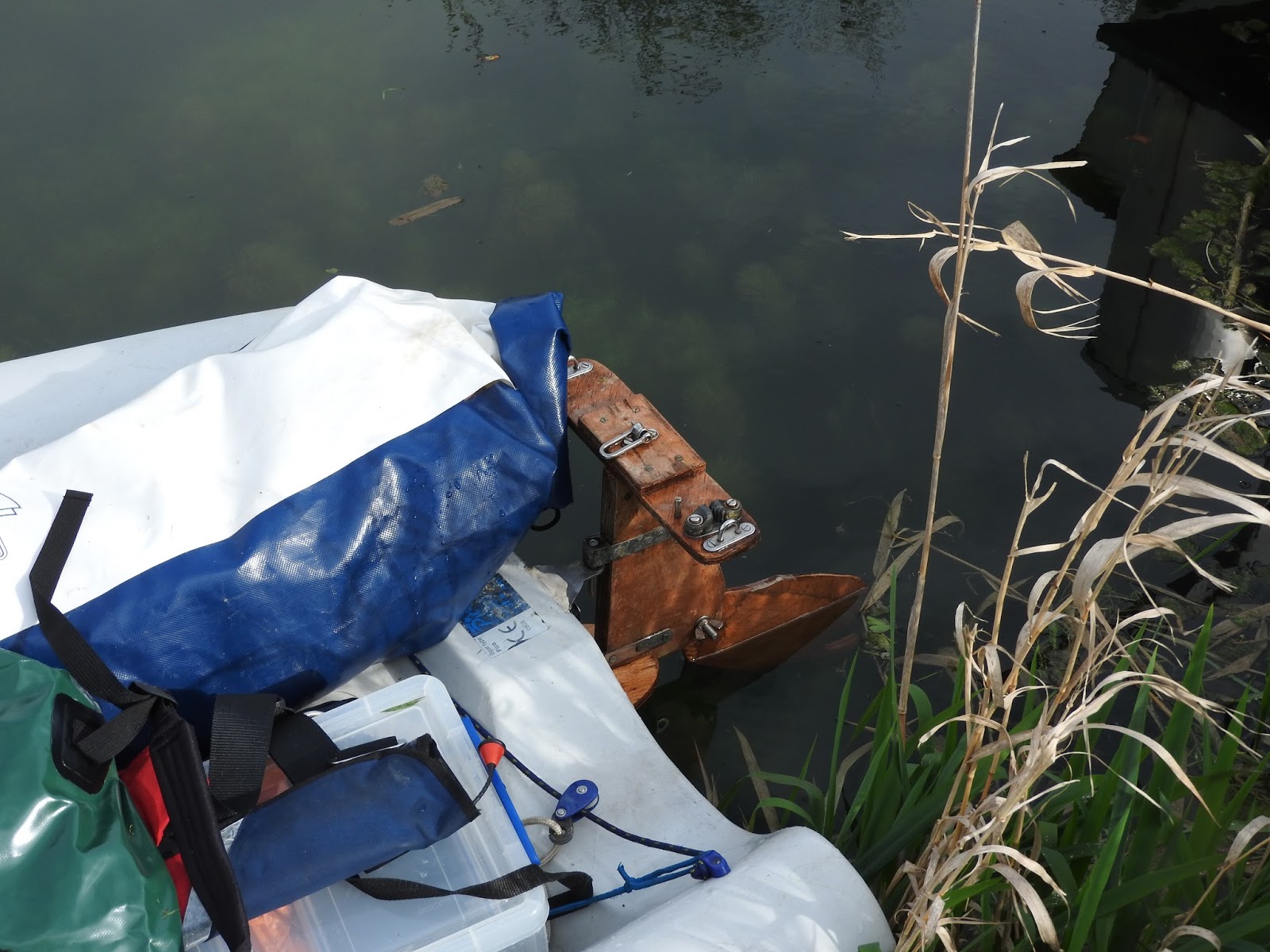
So  in the Grand Canal I used my small rudder with the blade at a horizontal angle such that the weed would pass under it. I also reshaped the blade slightly to reduce the chance of weed getting stuck.
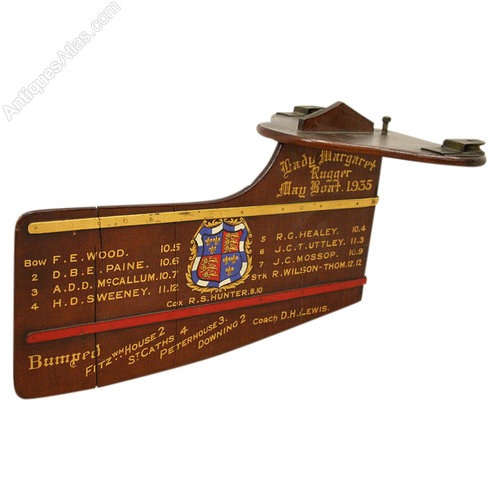
I realised that the rudder shape then looked a bit like rudders of the old wooden skiffs and racing shells, this one decorated and given to the cox of a rowing eight, when the eight had 'bumped' four times in the Cambridge University summer college rowing races.

Another problem was that the canal locks in Ireland do not have ladders going down into them. If you are on your own, when you paddle the boat into the lock there no way to get in and out to operate the lock gates.


To solve this, I took a chain ladder, designed for climbing down the side of houses in the event of a fire. I combined it with a knotted rope with loops which I used to clip onto, my life jacket having a harness. I carefully checked the bollards to ensure they would take my weight.


I took the top chains and used u-bolts to attach them to a strong piece of wood.I then drilled two holes in this wood and passed the a rope through it to make an attachment rope. This could be knotted together to create a loop to pass over the bollard.


I purchased a chain ladder that was re-usable. I used the excellent Saf-Escape fire escape ladder, as shown above, removing the metal structure that is used to hook over the window frame (Please note that, of course, no recommendations are made by the manufacturer to adapt their ladder).

I used the chain ladder for about 20 locks, the lock keeper helping with about four. Although the lock keepers will help with solo voyagers, in practice coordinating the timing out of season would have slowed me up too much. I don’t know of anyone else who has used this method, but it worked very well and saved a lot of time, being quick to set up. 


I didn't anticipate this, but when I got to Banagher, on the River Shannon, the walls of the port were especially high, more suited to the high sided cruisers. I was able to get out by running  a rope over a bollard and hauling up the ladder for use.


bike mirror

I also decided to use a bicycle mirror. I found this one, with a bendy arm that easily bolted on to a rowing rigger. The bendiness was very robust and I was able to bend it in when going through the locks and angle it back quickly in the right position. The mirror gives a very small picture, but enough to glance at and see if there is anything oncoming.


As mentioned in a previous post, I also took a bicycle with me on many of the trips. This proved surprisingly easy and I attached it to a short mast in an upright position. Of course you have to be careful not to drop it in the canal. Having a bike increased my range enormously at the finish of each day, up to 15 miles on this trip. I didn’t use it for all the journeys because by the end the countryside around about was getting very hilly.

In all I travelled 121.1 miles, averaging about 12 miles a day, discounting a day in Killaloe when I had to wait for permission to go through the Ardnacusha lock. The first day was the most energetic, with about 16 miles and 7 locks. I started at about 9.30 am and finished 8.00 pm, this experience making me realise my schedule was too ambitious, so I scaled back the distances/ number of locks on any subsequent days. I found the locks tended to take longer than expected, up to 40 minutes.

Start Hazelhatch
Day 1. Binn’s Bridge Robertstown  - 15.9 miles – 7 locks (two portage)
Day 2. Colgan’s Bridge, Near Edenderry –  11.2 miles – 1 lock
Day 3. Chenevix Bridge, Ballycommon – 14.0 miles – 0 locks
Day 4. Huband Aqueduct, near Tullamore –  8.2 miles – 9 locks
Day 5. Belmont Bridge and lock – 15.5 miles – 2 locks
Day 6. Junction with the river Shannon  and then on the Shannon to Banagher - 6.4 miles 5 locks
Day 7. Portumna Bridge and quay, Lough Derg - 12.6 miles – 1 lock
Day 8. Garrykennedy, Lough Derg - 14.9 miles
Day 9. Killaloe -  8.6 miles
Day 10. Stayed in Killaloe
Day 11. Limerick – 14.3 miles


Total distance: 121.6 miles