Other PicoMicroYacht

Friday, 5 May 2017

PicoMicroYacht and the sea at Doolin - another visit and another time


In a December post last year, 'Irish Adventure in the Offing,' I had mentioned that if PicoMicroYacht got to the west coast of Ireland I would then do some sea rowing and 'If the weather is settled and calm, there could be a few voyages out into the Atlantic Ocean.'

I would join my fourdaysrunning friends - they would run along the cliff tops and I would row along the coast from Doolin, or maybe visit the Aran Islands.

The strong winds and high waves meant it did not work out but I was able to observe the beautiful view across to the Islands from the Cliffs of Moyer. The striations in the picture show the length of the waves, the squall traces on the water in clusters across the panorama.


Another visit and another time and PicoMicroYacht would hope to get to those islands.


But the runners completed their 100K, this their start. See if you can spot the Olympic bronze medalist and the singer in the line up.


The singer is Gari Glaysher, his latest album a collection of Irish songs, including a beautiful duet, 'The Parting Glass,' performed with Hattie Webb.

The Parting Glass - from the lyrics by Ed Sheeran

'A man may drink and not be drunk
A man may fight and not be slain
A man may court a pretty girl
And perhaps be welcomed back again
But since it has so ought to be
By a time to rise and a time to fall
Come fill to me the parting glass
Good night and joy be with you all
Good night and joy be with you all'


Monday, 1 May 2017

PicoMicroYacht problem solving in Ireland


Canal voyaging was new to me, the most similar trip being on the River Wey the previous autumn.

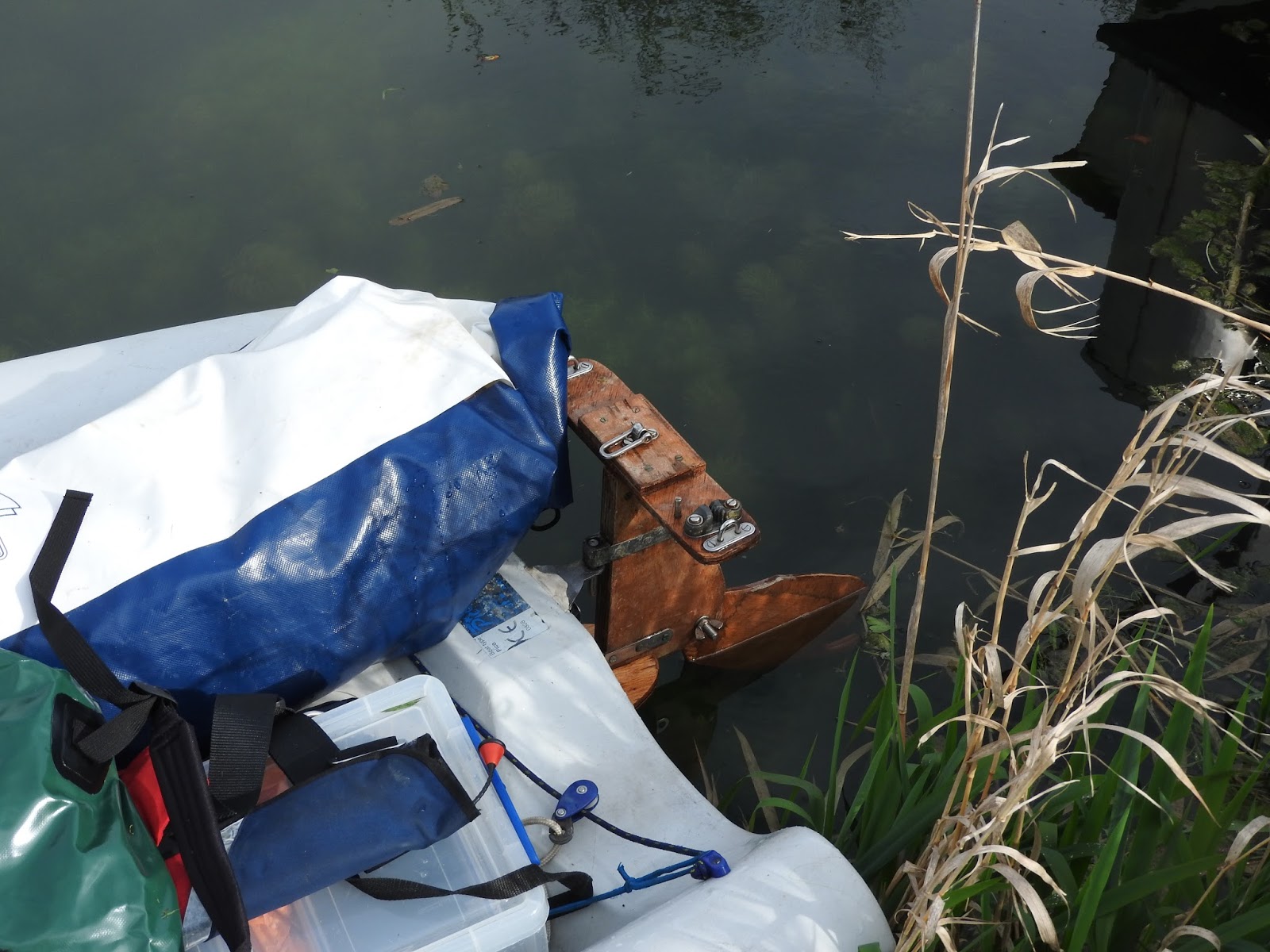
I had anticipated problems with weed. As well as fowling the locks, the weed gets caught on the rudder or skeg and slows the boat down. A normal sea or lake rudder swings down vertically, the depth providing balance and efficiency. But in the Grand Canal the weed would rapidly accumulate. 

In addition, recent reed cutting had left piles of debris to row through. The weed problem seemed to improve the further west I went.


So  in the Grand Canal I used my small rudder with the blade at a horizontal angle such that the weed would pass under it. I also reshaped the blade slightly to reduce the chance of weed getting stuck.
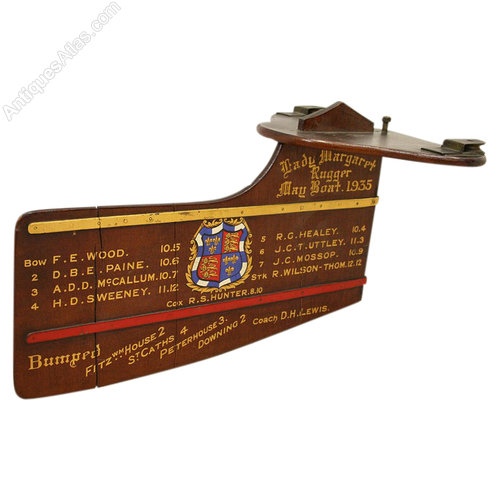
I realised that the rudder shape then looked a bit like rudders of the old wooden skiffs and racing shells, this one decorated and given to the cox of a rowing eight, when the eight had 'bumped' four times in the Cambridge University summer college rowing races.

Another problem was that the canal locks in Ireland do not have ladders going down into them. If you are on your own, when you paddle the boat into the lock there no way to get in and out to operate the lock gates.


To solve this, I took a chain ladder, designed for climbing down the side of houses in the event of a fire. I combined it with a knotted rope with loops which I used to clip onto, my life jacket having a harness. I carefully checked the bollards to ensure they would take my weight.


I took the top chains and used u-bolts to attach them to a strong piece of wood.I then drilled two holes in this wood and passed the a rope through it to make an attachment rope. This could be knotted together to create a loop to pass over the bollard.


I purchased a chain ladder that was re-usable. I used the excellent Saf-Escape fire escape ladder, as shown above, removing the metal structure that is used to hook over the window frame (Please note that, of course, no recommendations are made by the manufacturer to adapt their ladder).

I used the chain ladder for about 20 locks, the lock keeper helping with about four. Although the lock keepers will help with solo voyagers, in practice coordinating the timing out of season would have slowed me up too much. I don’t know of anyone else who has used this method, but it worked very well and saved a lot of time, being quick to set up. 


I didn't anticipate this, but when I got to Banagher, on the River Shannon, the walls of the port were especially high, more suited to the high sided cruisers. I was able to get out by running  a rope over a bollard and hauling up the ladder for use.


bike mirror

I also decided to use a bicycle mirror. I found this one, with a bendy arm that easily bolted on to a rowing rigger. The bendiness was very robust and I was able to bend it in when going through the locks and angle it back quickly in the right position. The mirror gives a very small picture, but enough to glance at and see if there is anything oncoming.


As mentioned in a previous post, I also took a bicycle with me on many of the trips. This proved surprisingly easy and I attached it to a short mast in an upright position. Of course you have to be careful not to drop it in the canal. Having a bike increased my range enormously at the finish of each day, up to 15 miles on this trip. I didn’t use it for all the journeys because by the end the countryside around about was getting very hilly.

In all I travelled 121.1 miles, averaging about 12 miles a day, discounting a day in Killaloe when I had to wait for permission to go through the Ardnacusha lock. The first day was the most energetic, with about 16 miles and 7 locks. I started at about 9.30 am and finished 8.00 pm, this experience making me realise my schedule was too ambitious, so I scaled back the distances/ number of locks on any subsequent days. I found the locks tended to take longer than expected, up to 40 minutes.

Start Hazelhatch
Day 1. Binn’s Bridge Robertstown  - 15.9 miles – 7 locks (two portage)
Day 2. Colgan’s Bridge, Near Edenderry –  11.2 miles – 1 lock
Day 3. Chenevix Bridge, Ballycommon – 14.0 miles – 0 locks
Day 4. Huband Aqueduct, near Tullamore –  8.2 miles – 9 locks
Day 5. Belmont Bridge and lock – 15.5 miles – 2 locks
Day 6. Junction with the river Shannon  and then on the Shannon to Banagher - 6.4 miles 5 locks
Day 7. Portumna Bridge and quay, Lough Derg - 12.6 miles – 1 lock
Day 8. Garrykennedy, Lough Derg - 14.9 miles
Day 9. Killaloe -  8.6 miles
Day 10. Stayed in Killaloe
Day 11. Limerick – 14.3 miles


Total distance: 121.6 miles

Sunday, 30 April 2017

PicoMicroYacht - The Ardnacusha


PicoMicroYacht goes to Ireland  - the Ardnacrusha

The last leg of my Ireland crossing was from Killaloe to Limerick, through a huge lock called Ardnacusha, part of a hydroelectric system constructed by a German firm with Irish design and labour force in the 1920s.


The Ardnacusha hydroelectric system - the lock entrances and exits are on the right

Ireland had just had seven years of independence from the British when it was built, consuming one fifth of their annual budget. The lock is the deepest in Europe, going down 102 feet.


Upstream there is an artificial lough that acts as a sump and exiting this is a weir system with a large vertically lifting sluice gate that lets you into a seven mile long conduit to the lock. You have to book at least two days in advance to go through the gate and then the Ardnacusha lock.


The gate at the Parteen Weir System

When I got to the gate it was well and truly shut and my thoughts were that they had forgotten about me. 


There was a huge downpour and I sat in the boat under a tarp on the boat contemplating what to and looking at the Siemens-Schuckert weir architecture. But then a ‘knee-naw’ warning signal went off and the gate started to open, although I never saw anybody operating it.


I was now in the conduit and left the gate behind. The next seven miles seemed to go quickly.


I arrived at the jetty just before the entrance to the lock.


Soon I was in. The first drop is about 60 feet and I was now down at the bottom. Looking up, I saw some workmen who had come over to have a look, waving from the top. 


The door then opened and I could paddle into a second contiguous lock.


This lowered me down and I waited for the opening it's door. In all it took around 50 minutes to complete the lock cycle.


I was now able to exit the Ardnacusha and was on my way to Limerick.


As the waterway eventually opened out I passed some fishing boats. They also used oars for propulsion.

I had planned to go through the sea lock into the Shannon Estuary and finish my voyage there. But had found out it only opened once a week and for a few hours, the next opening time in five days.


There were only two slipways before the lock and I found one, at the the Barrack Land Boatman’s Club. A club member was very helpful in allowing me to use their slipway, so that I could get PicoMicroYacht out of the water to finish up.

Friday, 28 April 2017

PicoMicroYacht goes to Ireland – the Shannon

As I exited into the Shannon the pretty, concise and restricted work of the canal disappeared and was replaced by grandeur and wild beauty, a bit like the Norfolk Broads in England, but without all those the boats.


On distant banks swans were nesting.


I spied people working on the banks, including a reed cutter.


Although I was warm from the rowing there was a biting chill in the air and those fishing were well dressed, although could have looked like pirates in a different context.


The cruisers I did see where on hired boats, easy to spot by the number of fenders they use.


Fishing stages made a good stop-off point for lunch.


After two days I was in Lough Derg, a 20 mile long inland lake large enough to be cautious about the weather.


I started flying my Irish courtesy flag (a flag to be flown by a ship visiting another country), as I crossed the lough.


The wind can get up very quickly. At one point I stopped on the lough to observe the waves and their bumpiness.


Some fierce people fishing strayed near to the navigation mark, so I had to go the wrong side and avoid their fishing lines.


The lake calmed and I was setting off on my way to the base of the lough, towards Killaloe, It had taken three days so far in the Shannon river system and and my final voyage  to Limerick was yet to come. 

Thursday, 27 April 2017

PicoMicroYacht goes to Ireland – The Grand Canal

The plan was for PicoMicoYacht to voyage across Ireland from Dublin to Limerick, firstly on the Grand Canal and then down the mighty River Shannon, through Lough Derg.


The night before I set off, I met up for a drink with an ex colleague Niall, a Dubliner who had worked in London and moved back to Dublin to set up a department in one of the large hospitals (Ian 'Elvis' Robertson was on this world travels - see previous blog). We had halves, because he was driving and I was about to set off. Conversation went like this:


Niall: What’s it like setting off?

Me: Well I am having to avoid starting in the centre of Dublin because I have been warned off going through the rough areas on the canal on my own with all my gear – a pity because I will miss out on the views – so I am setting off from the outskirts….’

Niall: Yes I have heard..

Me: Actually I am more worried now about the weed.

(at this point Niall looks quizzical for about a second to two)

Me: (laughing) no not that type of weed…

It turned out that Niall had a great grandfather who was a lock keeper in the stretch of river I would be rowing, living at Allenwood, near the end of my first day.


I duly set off and immediately reached a double lock. This is two locks arranged contiguously. I got into the first one but the weed seemed to block the next one up, so I had to portage PicoMicroYacht. I was right about the weed.


I had a new strategy to take a bicycle with me, the plan being to cycle back to my base each day and fetch the car.

It partially worked, but I misjudged what was achievable, and the seven locks and fifteen miles on the first day, with two portages and a bike ride at the end was a little too much and on the subsequent days I had to reduce my distances.


The bridges were quaint and include remains of light lifting bridges, works of art in their own way.


Initially, many of the houses along the canal had large dogs who would come out to take a look.


Eventually I caught up with the weed cutter and gatherer boats who have a busy time on the canal.


The days flew by along the canal as I admired the beauty of the landscape and tried to keep rowing.


It was relaxing rowing mile after mile most of the time in a world of my own. Very few boats were seen and I had only one incident of having to get out of the way.


This motor cruiser looked more stressed as they negotiated the bridge.


For the fisherman it was I who was disturbing the peace.


Halfway along near Tullamore I saw the tell-tail signs of a rowing club.


It turned out to be the Offaly Rowing club and I passed their boats in training.


Along the way there were picturesque ruins of houses, stirring thoughts of long-lost histories and people of who might have lived by the river in distant times.


After five days I had reached the end of the Canal and was at Shannon Harbour, which had a faded glory look.  The distance so far was about 70 miles.

The peacefulness of the Grand Canal is captured in a poem by Michael Hensey (1950-2005).

Grand Canal, Tullamore

I used to love to sit by the old lock gate
and hear the tumbling waters roar
in carefree dreamy boyhood days
in dear sweet Tullamore

The summer air held a magic rare
with charm the soul to enthral
in restful eves along the spangled leaves
on the green, grassy banks of the grand canal.

From the book 'Stars on Still Water' by Michael Hensey.

Sunday, 26 February 2017

The butterfly effect and PicoMicroYacht voyaging


Stay with me with this one, but I will get there. Everybody knows the butterfly effect, discovered by Edward Lorenz. Technically defined, 'a small perturbation in the initial condition of a system results in large changes in later conditions.' Very small beginnings can have huge consequences. 


A butterfly flapping it's wings in Mexico will eventually set in chain sequence of events that causes a typhoon in China.  For humans, as someone has said, faith as small as a mustard seed can move mountains.

CASPA is an amazing charity working with children, young people and families affected by autism in South East London. I know this because I have spoken to some of the families involved and for some it has been life transforming.

My friend Ivor found a way of making CASPA happen just because one day he got up and thought 'I really should get some exercise' and he went for a jog. 

One thing led to another  and he thought 'I should get other people involved' and some friends went jogging with him. Then the friends thought' 'we really should have a go at some of these running events and do it for charity'. This is how fourdaysrunning was born and every year Ivor organises a running event, the mainstay fundraising for CASPA.


Ivor  Reveley presenting a cheque to CASPA from the fourdaysrunning event: each year the money comes in and it is spent gratefully and wisely


Ivor, clutching that cheque in the photo above, badgered me into joining in. Well, I can't run very well, but I can row in small boats. So starting in 2013, Ivor invited PicoMicroYacht to join fourdaysrunning. 

The joggers would run and I would row in the sea or river nearby and we would wave to each other along the way. Four years later, PicoMicroYacht has been inspired to row round the west of Cornwall (PicoMicroYacht's Cape Horn), the length of the Thames (Tom Sawyer eat your heart out) river  and round the Isle of Wight (an epic voyage for PicoMicroYacht)

Their next adventure is to run along the wild and rugged west coast of Ireland. PicoMicroYacht will be joining them, rowing, firstly 130 miles across Ireland  from Dublin to Limerick, timing the arrival for the start of their fourdays 100K run at the end of April.


PicoMicroYacht is getting ready, with some sanding down and a few coats of varnish. Little modifications are being done such as some plywood boards to rest on when I stop and a better tent to sleep in. The rowing machine is getting longer workouts.The runners are training harder and the excitement is building.